- A study by Promotora Social México and the Early Childhood Pact proposes 11 key areas of focus to improve the life trajectories of children under 6 in Mexico
- Mexico allocates 0.6% of its GDP to early childhood, less than half of the 1.5% recommended internationally (Inter-American Dialogue, 2024).
- The study proposes 11 key areas of focus, with short-, medium-, and long-term transition strategies, to ensure that all children under the age of 6 have a better start in life.
- High-quality early childhood development programs can generate a return of up to 13% per year for each child, according to Nobel Prize-winning economist James Heckman.
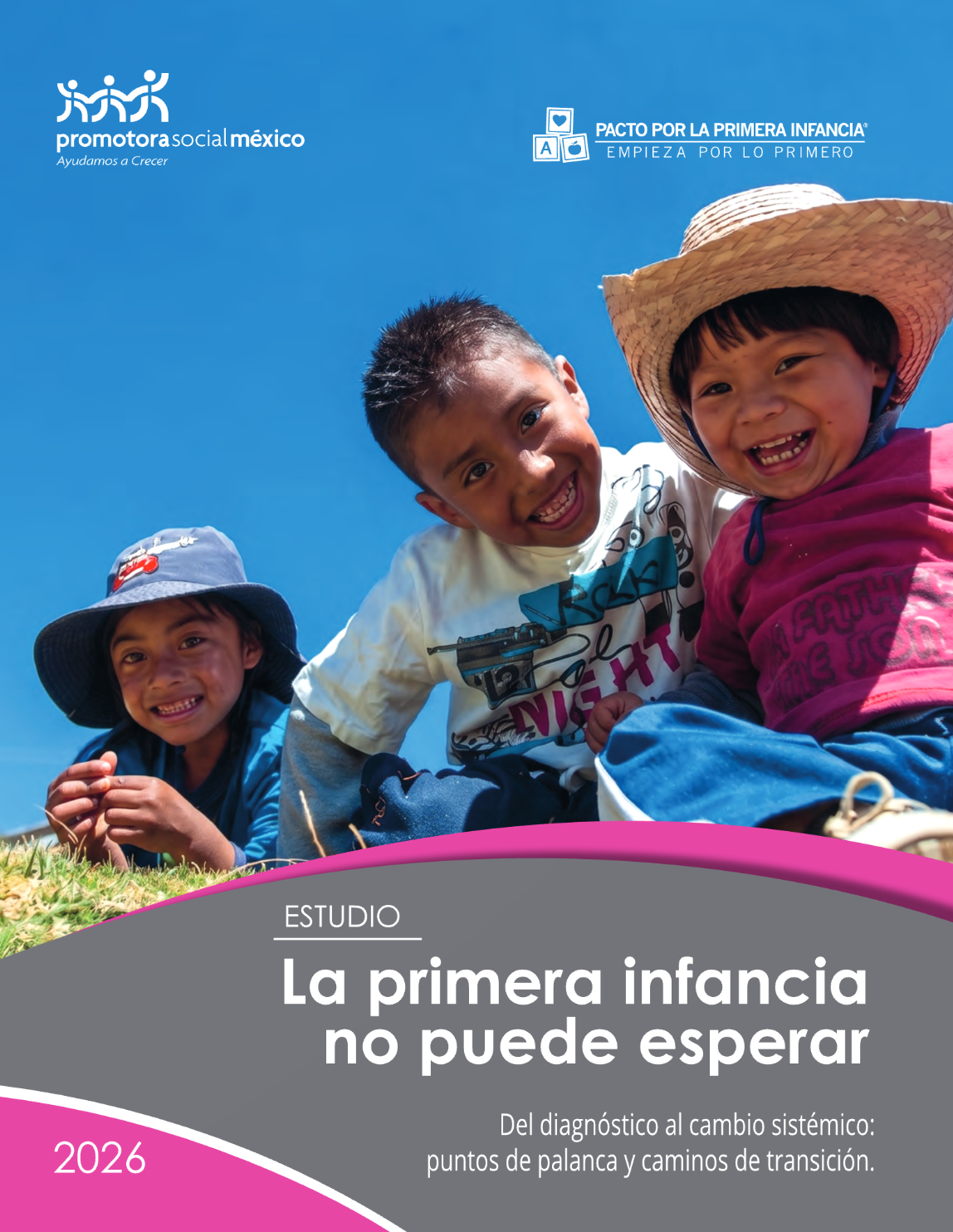
Mexico City, November 11, 2026.— Promotora Social México (PSM) and the Early Childhood Pact (PPI) present the study “Early Childhood Can’t Wait: From Assessment to Systemic Change, ” which analyzes the situation of children under 6 years of age in the country and proposes concrete actions to improve their development. According to PPI estimates based on INEGI microdata (2024), 41.9% of this population lives in poverty.
The study consists of two components: an assessment, based on official statistics and a literature review; and a systemic analysis, based on 24 interviews with experts from the public, private, and academic sectors, civil society, and international organizations, as well as four focus groups with mothers, fathers, and primary caregivers, educators, and early childhood specialists.
Key Findings of the Assessment
- In 2024, nearly 4 out of every 10 children under the age of 6 (37.8%) lacked access to health services (INEGI, 2024).
- Less than half of infants under 1 year of age (45.6%) have completed their vaccination schedule (ENSANUT 2021–2023), and chronic malnutrition affects 13.9% of children under 5 years of age (ENSANUT 2020–2023).
- Only 3.6% of children under age 3 receive formal early childhood education, even though it has been a constitutional right since 2019 (SEP, 2023–2024 school year).
- Only 1 in 3 infants under 6 months of age (34.2%) is exclusively breastfed (ENSANUT 2021–2023).
- Half of the children aged 1 to 4 (50.4%) were subjected to violent disciplinary methods in the month prior to the survey, although this figure was down from 58.9% in 2018–2019 (ENSANUT 2021–2023).
The study also highlights progress, such as the constitutional recognition of early childhood education as a right (2019). At the same time, it points to opportunities to strengthen coordination among institutions and increase investment.
From Diagnosis to Action: 11 Key Leverage Points
Based on a systemic map, the study identifies 11 leverage points: areas where small actions can generate significant impacts. These were validated by specialists, are aligned with the PPI’s institutional goals and conditions, and each includes short-, medium-, and long-term transition pathways:
| 1. Inter-institutional coordination and binding intersectoral governance. | 7. Ensure access to comprehensive, coordinated, and culturally appropriate services. |
| 2. Harmonize and strengthen the legal framework. | 8. Ensure development through accessible health and nutrition services focused on early childhood. |
| 3. Strategic financing and a rights-based public budget. | 9. Ensure well-being through a framework that incorporates a life-cycle approach, rights, equity, and territorial justice. |
| 4. National Early Childhood Information System. | 10. Promote comprehensive models of education and care. |
| 5. A well-trained workforce with the appropriate qualifications. | 11. Ensure protection and safe environments from early childhood onward. |
| 6. Build a collective and shared commitment to early childhood. |
“This study helps us clearly see where we can join forces to improve the lives of girls and boys. The 11 leverage points build on what the country has already achieved and aim to ensure that the government, civil society, the private sector, and families continue to work together, based on evidence,” said Gustavo Payán Luna, Director of Strategy and Evidence for Systemic Impact at Promotora Social México.
“Transforming the reality of early childhood requires much more than isolated efforts: it involves changing the systemic conditions that currently determine the lives and opportunities of millions of girls and boys. This study has allowed us to co-create a collective vision, understand the root causes of inequalities, and identify 11 leverage points that will enable us to move toward comprehensive, coordinated, and sustainable solutions. Because guaranteeing the rights of every girl and every boy—today and in the future—should not depend on where they are born, but on our collective ability to transform their reality,” said Aranzazu Alonso, Executive Director and General Coordinator of the Early Childhood Pact.
The document calls for shared responsibility among the government, civil society, the private sector, families, and the media. The full study is available for viewing and download at https://reportes.psm.social/pdf/estudio-la-primera-infancia-no-puede-esperar-2
About Promotora Social México
An organization with more than 15 years of experience in social and impact investing. Through strategic projects in early childhood, education, health, youth, and social entrepreneurship, it has helped improve the living conditions of more than 4.3 million people. With a national presence and international partnerships, PSM brings together stakeholders, funds projects, and supports sustainable solutions that address the most urgent structural challenges. For more information, visit: www.psm.org.mx
About the Early Childhood Pact
A citizen-led advocacy and collective impact initiative comprising more than 500 organizations from civil society, academia, and the private sector, which seeks to make early childhood a national priority and achieve 12 goals by 2030. For more information, visit: https://www.pactoprimerainfancia.org.mx/